
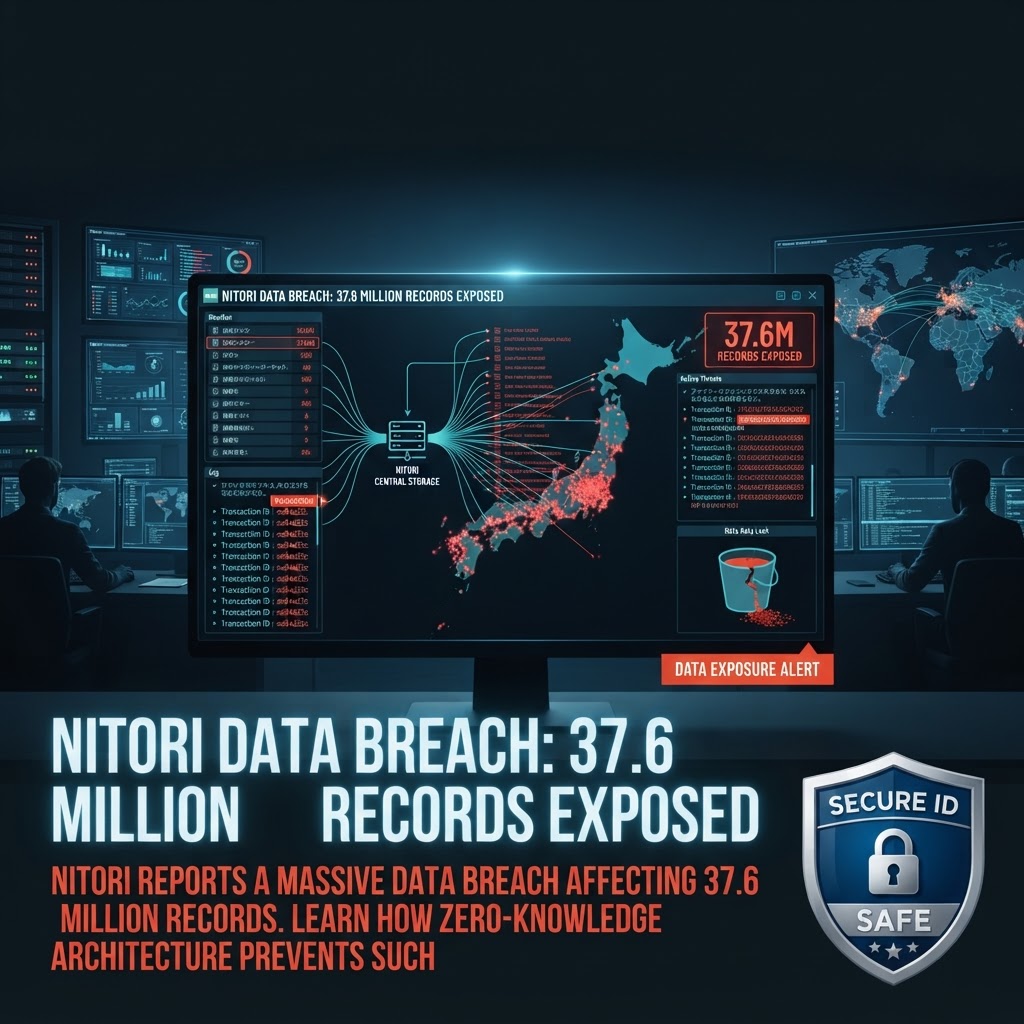
What happened
Japanese furniture and home-goods retailer Nitori disclosed that unauthorized access to its servers, occurring between mid-October and early November 2026, potentially exposed up to 37.62 million personal records. The compromised data includes membership numbers, names, physical addresses, telephone numbers, and dates of birth.
Why this matters
This incident represents one of the largest data exposures of the year, providing threat actors with a massive repository of PII that can be used for sophisticated social engineering, identity theft, and targeted phishing campaigns. When millions of records are stored in a centralized database, a single point of failure can compromise the privacy of an entire customer base.
How zero-knowledge changes this
SecureIDsafe’s architecture is designed specifically to neutralize the impact of such breaches. By utilizing AES-256 client-side encryption, all sensitive user data is encrypted on the user's device before it ever reaches our servers. Because we hold no keys—only the user does—our storage is strictly ciphertext-only. Even if an attacker were to gain unauthorized access to our infrastructure, they would find only indecipherable data, not the PII of millions of users. Furthermore, our non-bypassable 24-word BIP-39 seed recovery ensures that even in the event of device loss, the user maintains exclusive control over their data, preventing the provider from ever becoming a target for mass data exfiltration.