
What happened
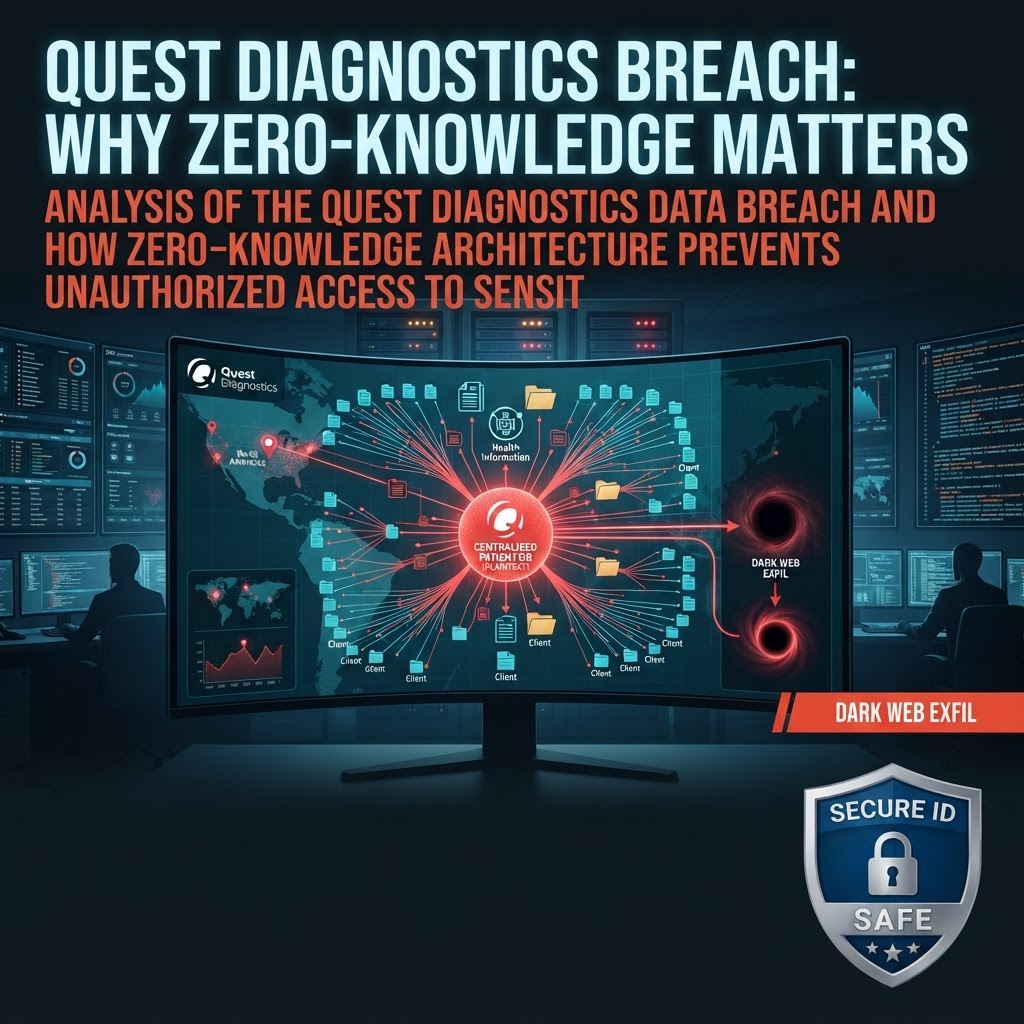
Quest Diagnostics recently confirmed a significant data breach involving unauthorized access to its Quanum Laboratory Services Manager (LSM) system. The incident, discovered on October 21, 2026, resulted in the exposure of sensitive patient records, raising alarms regarding the security of clinical laboratory data stored within centralized enterprise environments.
Why this matters
When healthcare providers store patient data in centralized databases, they create a 'honeypot' for attackers. Once a threat actor gains unauthorized access to the server, they can often scrape the entire database in plaintext. This exposes individuals to long-term risks, including medical identity theft and targeted phishing, as the stolen information is often permanent and cannot be 'reset' like a password.
How zero-knowledge changes this
SecureIDsafe’s architecture is designed specifically to neutralize the impact of such breaches. By utilizing AES-256 client-side encryption, all data is encrypted on the user's device before it ever reaches the server. Because the provider never holds the device-derived keys, the server acts only as a blind repository for ciphertext. Even if an attacker successfully breaches the Quanum LSM system or any similar platform built on our architecture, they would only find indecipherable ciphertext. Without the user's unique, non-bypassable 24-word BIP-39 seed, the data remains mathematically inaccessible to the attacker, the provider, and any unauthorized third party. In a zero-knowledge ecosystem, a server breach does not equate to a data breach.