
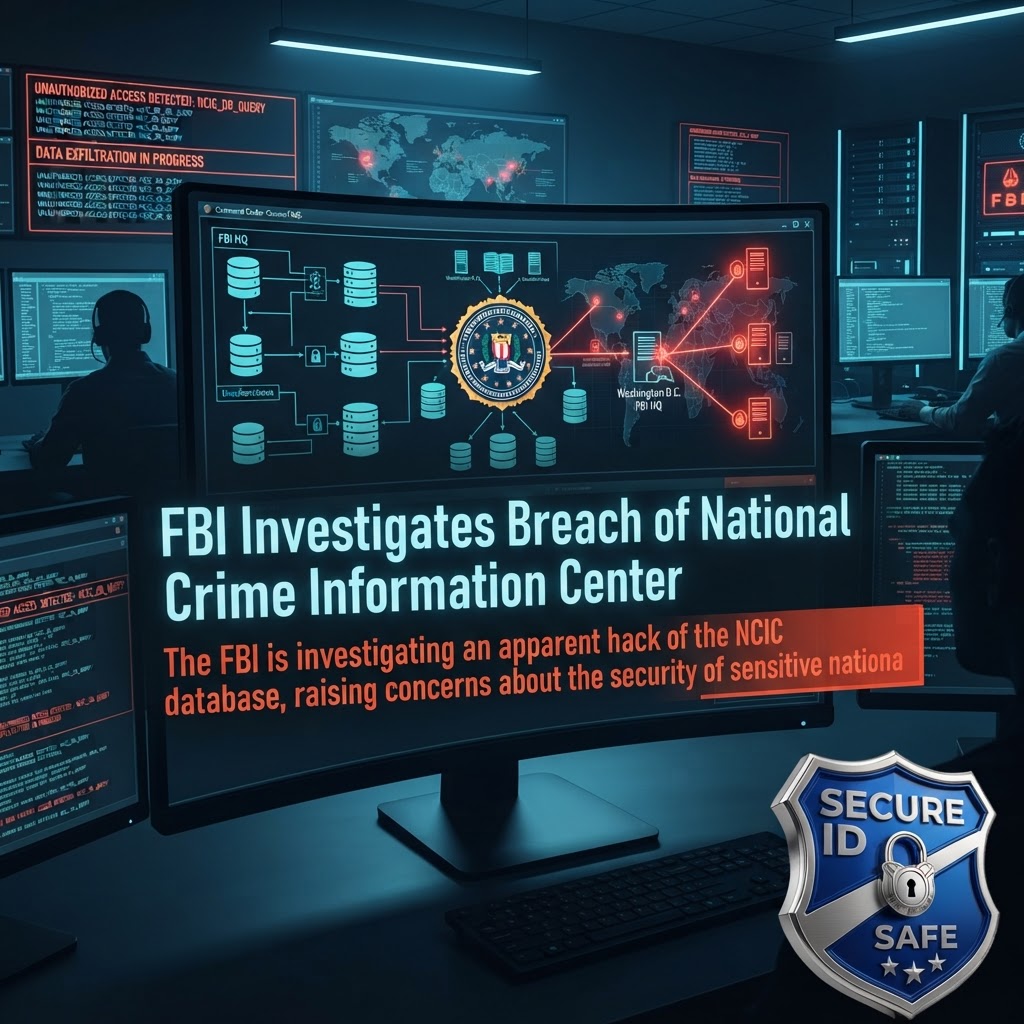
What happened
The FBI has confirmed it is investigating an apparent breach of the National Crime Information Center (NCIC) database, a central repository used by law enforcement agencies across the United States to share criminal justice records, warrant information, and sensitive investigative data. While the full scope of the intrusion remains under investigation, the incident highlights a significant compromise of a high-value government target.
Why this matters
This breach represents a critical failure in the protection of sensitive law enforcement data. If threat actors have gained access to the NCIC, they may possess the ability to track active investigations, identify undercover operations, or manipulate warrant data, creating severe risks to public safety and national security. The speed at which such databases are being targeted underscores the increasing sophistication of state-sponsored or highly organized criminal groups.
How zero-knowledge changes this
SecureIDsafe’s architecture is designed to neutralize the impact of such breaches through a zero-knowledge, client-side encryption model. In a system like ours, even if an attacker gains administrative access to the underlying database or storage infrastructure, they would only encounter encrypted ciphertext. Because SecureIDsafe utilizes AES-256 client-side encryption with device-derived keys that the provider never holds, the data remains mathematically inaccessible to the server host. Furthermore, our non-bypassable 24-word BIP-39 seed recovery ensures that even in the event of a total system compromise, the master keys required to decrypt the data are never stored on the server. By ensuring that the service provider acts only as a blind storage layer, we ensure that a breach of the infrastructure does not equate to a breach of the user's sensitive information.