
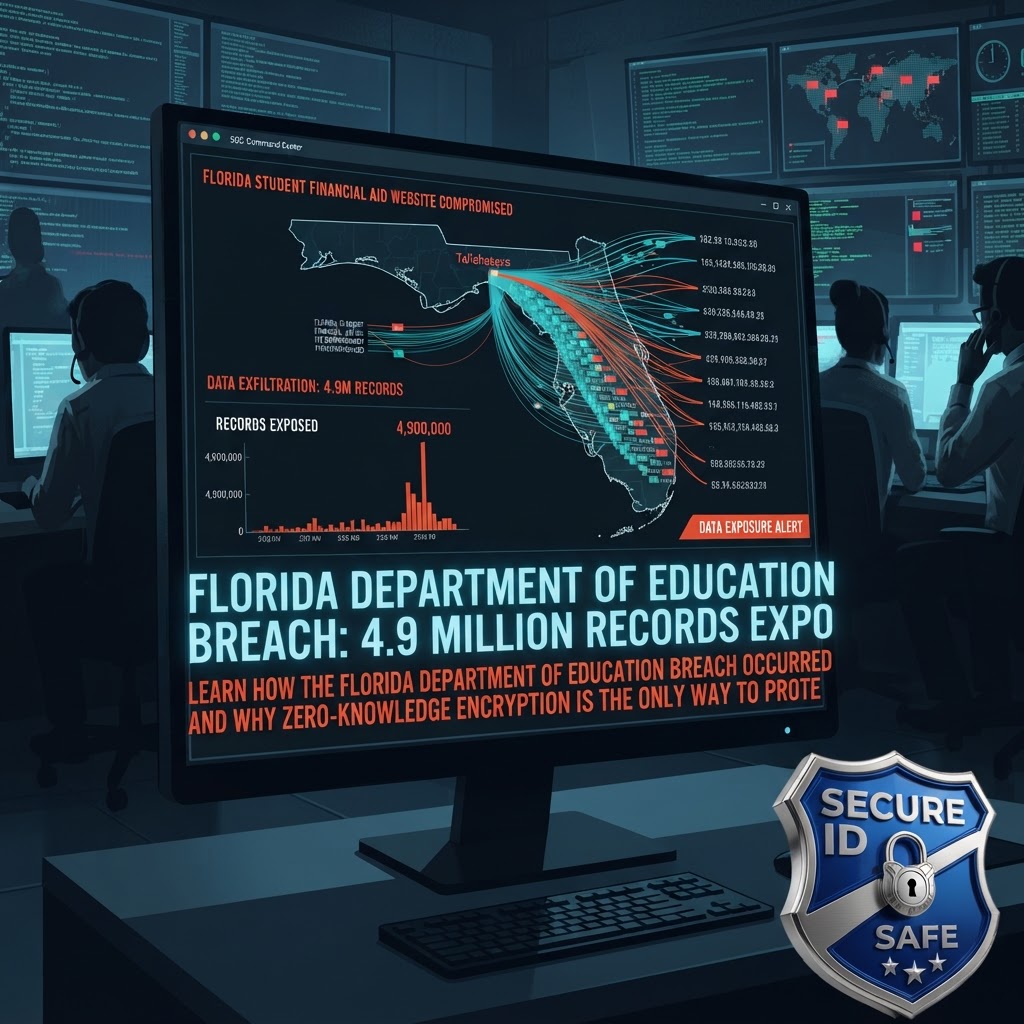
What happened
The Florida Department of Education recently confirmed that its financial aid portal, FloridaStudentFinancialAidSG.org, was the target of unauthorized criminal access. The breach, discovered on October 19, resulted in the exposure of names, addresses, phone numbers, email addresses, dates of birth, and Social Security numbers for approximately 4.9 million people.
Why this matters
This incident highlights the catastrophic risk of storing sensitive PII in centralized, unencrypted databases. When government agencies or service providers maintain "cleartext" repositories of highly sensitive data, a single point of failure allows attackers to exfiltrate millions of records instantly. This data is now likely circulating on dark-web forums, fueling a long-term risk of identity theft, financial fraud, and targeted phishing campaigns against the affected students and families.
How zero-knowledge changes this
SecureIDsafe neutralizes this type of exposure through a zero-knowledge architecture. In our system, data is encrypted at the client-side using AES-256 before it ever reaches our servers. Because we utilize device-derived keys that we never hold, the provider is incapable of accessing the underlying data. Even if an attacker were to breach our storage infrastructure, they would only find useless, encrypted ciphertext. Furthermore, our non-bypassable 24-word BIP-39 seed recovery ensures that users maintain absolute custody of their data, preventing the kind of mass-exfiltration that occurs when centralized authorities hold the "master keys" to their users' most sensitive information.